Mapping the Wounded Self: Why American Trauma Therapists Are Turning to India's Ancient Chakra System
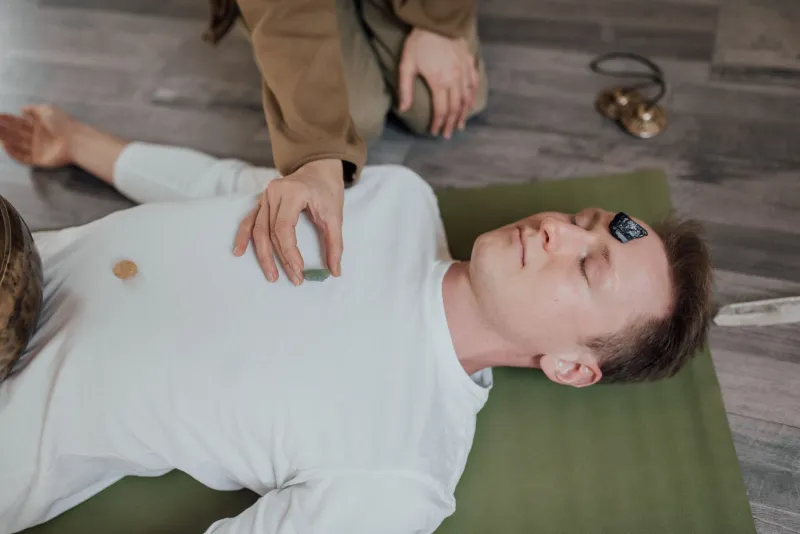
In a modest therapy suite in Boulder, Colorado, a licensed clinical social worker named Rachel Ostroff keeps two items on her desk that might seem incongruous at first glance: a well-thumbed copy of Bessel van der Kolk's The Body Keeps the Score and a laminated chart of the seven chakras, annotated in her own handwriting with clinical observations accumulated over a decade of practice. To Ostroff, these two objects are not in tension. They are, she says, speaking the same language through different vocabularies.
"When a patient describes feeling like something is lodged in their chest, or that their throat closes whenever they try to speak their truth, Western clinical language gives me limited tools to work with that phenomenology," she explains. "The chakra framework gives me — and more importantly, gives them — a precise, dignified way to locate and name what is happening inside their body."
Ostroff is not alone. Across the United States, a growing cohort of licensed therapists, somatic practitioners, and trauma specialists are incorporating the chakra system — rooted in ancient Indian philosophical and yogic traditions dating back thousands of years — as a supplementary framework for understanding emotional wounding, developmental trauma, and post-traumatic stress disorder. What was once confined to yoga studios and wellness retreats is now finding a considered, rigorous home within credentialed clinical practice.
An Ancient Map for a Modern Crisis
The chakra system, as articulated in Sanskrit texts including the Sat-Chakra-Nirupana and elaborated through centuries of Tantric and yogic scholarship, describes seven primary energy centers aligned along the spine — from the root, or Muladhara, at the base of the pelvis, to the crown, or Sahasrara, at the top of the skull. Each center is associated with specific psychological functions, emotional states, physiological regions, and developmental stages of human life.
The Muladhara, for instance, governs survival instincts, belonging, and physical safety — precisely the domain disrupted by early childhood neglect or chronic threat. The Anahata, or heart center, is associated with grief, compassion, and relational bonding. The Vishuddha, located at the throat, corresponds to authentic self-expression and the capacity to speak one's experience — an area that trauma research has long identified as critically impaired in survivors of abuse.
For clinicians trained in somatic therapies, attachment theory, and polyvagal neuroscience, these correspondences are difficult to dismiss as mere metaphor. "When you lay the chakra map alongside what we understand neurobiologically about trauma," says Dr. Ananya Mehrotra, a psychiatrist practicing in the San Francisco Bay Area who trained in both Western medicine and Ayurvedic principles, "the overlap is striking enough that it demands serious attention rather than reflexive skepticism."
From Metaphysics to Method
The practical integration of chakra awareness into trauma therapy takes many forms. Some practitioners use it primarily as a psychoeducational tool — offering patients a spatial, embodied vocabulary to describe internal states that resist articulation in conventional emotional language. Others incorporate it into somatic exercises, guiding clients to direct breath, movement, or focused attention toward specific regions of the body associated with particular energy centers.
Dr. Mehrotra describes working with a veteran patient who had cycled through multiple talk therapy modalities without sustained relief. "He could not access his emotional experience through narrative. It felt abstract and unsafe to him. But when we began working with the body itself — using the chakra framework to locate where the trauma was held — something opened. He began to feel, rather than simply report."
This shift from narration to sensation is consistent with what trauma researchers have long observed: that traumatic memory is stored not primarily in the cortex as a coherent story, but in subcortical and somatic structures as fragmented sensory and physiological imprints. Somatic therapies that work directly with bodily experience — including Somatic Experiencing, EMDR, and Sensorimotor Psychotherapy — have gained significant empirical support in recent years. The chakra system, practitioners argue, offers a culturally rich, symbolically resonant overlay that can deepen and accelerate this work.
Respecting the Source
Not everyone in the clinical community greets this development with unqualified enthusiasm, and thoughtful practitioners acknowledge the complexity of borrowing from a living spiritual tradition. The chakra system is not an abstraction invented for therapeutic convenience. It emerges from a sophisticated and deeply inhabited worldview — one that encompasses cosmology, ethics, devotional practice, and an understanding of the human being that extends well beyond the psychological.
"I am very conscious of the fact that I am working with something that belongs to a tradition I did not grow up in," says Ostroff. "I make it a practice to credit the origin explicitly with my patients, to encourage them to learn more about the Indian philosophical context if they are drawn to it, and to remain in ongoing dialogue with teachers who carry this knowledge from within the tradition itself."
Dr. Mehrotra, who grew up in a Hindu household and encountered the chakra system first as a devotional framework rather than a clinical tool, offers a perspective shaped by that dual inheritance. "There is a meaningful difference between appropriating a tradition and entering into genuine relationship with it," she says. "The question I ask myself is whether my use of this knowledge honors its depth or flattens it into mere technique. That is an ongoing discipline, not a question you answer once."
For Indian-American practitioners in particular, this moment carries a distinctive resonance. Many describe a professional lifetime spent navigating between two epistemological worlds — Western clinical training on one side, the embodied cultural and spiritual inheritance of their families on the other. The current interest among non-Indian colleagues in frameworks like the chakra system is, for some, a long-overdue acknowledgment that non-Western knowledge systems possess genuine intellectual and therapeutic authority.
What Patients Are Saying
Perhaps the most compelling evidence for the value of this integration comes from the patients themselves. Across practices, therapists report that the chakra framework resonates with striking frequency among clients who have felt unseen or inadequately served by purely biomedical or cognitive approaches to their suffering.
Many describe a sense of recognition — as though the system articulates something they have always sensed about their own inner landscape but lacked the language to express. Others, particularly those from South Asian backgrounds, find that engaging with this framework within a clinical context offers an unexpected form of cultural affirmation: a signal that the knowledge carried within their heritage is not merely quaint but genuinely useful in the most pressing circumstances of their lives.
"Healing is not a culturally neutral process," Dr. Mehrotra reflects. "The frameworks we use to understand suffering shape what becomes possible in recovery. When we expand the range of maps available to us, we expand the territory that can be healed."
A Dialogue Still Unfolding
The integration of the chakra system into American trauma therapy is neither complete nor without tension. Questions of training standards, clinical ethics, and the boundaries between spiritual direction and psychological treatment remain actively contested. Professional bodies have not yet established consensus guidelines, and the research base — while growing — remains modest relative to that supporting established somatic modalities.
What is clear, however, is that the conversation is serious, expanding, and unlikely to recede. As American mental health care continues its slow reckoning with the limits of purely verbal, cognitive approaches to human suffering, the ancient Indian understanding of the body as a layered, luminous, and deeply intelligent system offers a vocabulary that an increasing number of healers — and those they serve — find indispensable.
At Krushna Kunj, we believe that the wisdom traditions of India carry gifts whose value does not diminish with distance or time. In the therapy offices of a nation grappling with a mental health crisis of historic proportions, those gifts are finding new and consequential expression.