Bound by Devotion, Not Ambition: How the Gopi Circle Is Redefining Female Friendship in America
There is a particular exhaustion that accompanies modern female friendship in America. It arrives in the form of group chats that feel like performance stages, of coffee meetings that double as networking opportunities, of the subtle calculus women conduct before sharing a vulnerability: Will this be used against me? Sociologists have documented it, therapists name it in nearly every session, and countless essays have attempted to diagnose it. What fewer people have considered is that a solution might be encoded in a five-thousand-year-old devotional tradition from the banks of the Yamuna River.
The gopis of Vrindavan — the cowherd women who, according to Vaishnava scripture and the Bhagavata Purana, devoted themselves entirely to Krishna with a love that transcended obligation, hierarchy, and self-interest — are emerging as an unlikely archetype for a generation of American women rethinking what friendship is actually supposed to feel like.
Who Were the Gopis, and Why Does It Matter Now?
In the devotional literature of the Krishna tradition, the gopis occupy a singular theological position. They are not wives, not disciples in the conventional sense, and not supplicants seeking material reward. Their bond with Krishna — and crucially, with one another — is characterized by what Sanskrit texts call prema, a form of love so pure it has dissolved the very architecture of the self. They dance together in the Rasa Lila, they search for Krishna together when he disappears, and they console each other in his absence. Their community is not incidental to their spirituality; it is their spirituality.
What strikes contemporary readers, particularly women navigating the social terrain of American life, is how thoroughly the gopi model inverts the assumptions of modern female social dynamics. There is no competition among them for Krishna's attention — or rather, the texts suggest that the moment competition arises, the divine presence recedes. Their bond is deepened, not threatened, by shared longing. Joy is not hoarded but multiplied through collective expression.
"When I first read about the gopis seriously — not as a Sunday school story but as a philosophical framework — I was struck by how radically non-transactional they were," says Priya Mehta, a therapist based in the San Francisco Bay Area who works primarily with South Asian women. "They weren't building social capital. They weren't hedging. They were just... fully present to one another and to something larger than themselves. That's extraordinarily rare."
The Transactional Friendship and Its Discontents
Research published in the Journal of Social and Personal Relationships has repeatedly confirmed what most American women already sense intuitively: female friendship in the United States has become increasingly instrumentalized. The rise of professional networking culture, the gamification of social media engagement, and the productivity-first ethos of contemporary life have collectively reframed relationships as resources to be cultivated rather than bonds to be tended.
The consequences are measurable. A 2023 survey by the Survey Center on American Life found that American women reported significantly fewer close friendships than they did two decades ago, even as their social networks — measured by digital connections — expanded dramatically. The paradox is not difficult to explain: scale and depth are inversely related when the underlying logic of connection is transactional.
Into this landscape, the gopi model arrives with a quietly radical proposition: that the most sustaining form of female community is one organized around shared devotion to something beyond individual advancement.
Gopi Circles in Practice: What They Actually Look Like
Across the United States, small groups of women — some Hindu by heritage, many not — are experimenting with what practitioners are calling "gopi circles" or "devotional friendship circles." The formats vary considerably. In Atlanta, a group of twelve women meets monthly for kirtan, shared cooking, and what one participant describes as "structured vulnerability" — a deliberate practice of speaking truthfully without agenda. In Chicago, a circle that began as a Bhakti yoga study group has evolved into something its members describe as their primary community of emotional support. In Los Angeles, a women's arts collective has adopted the gopi framework explicitly, organizing their collaborative practice around joy and collective offering rather than individual portfolio-building.
What these groups share is less a specific ritual format than a shared orientation: the deliberate subordination of competitive self-presentation to something held in common. That common thread might be a deity, a creative practice, a text, or simply an agreed-upon commitment to showing up without performance.
"We made one rule at the beginning," says Ananya Krishnamurthy, a founding member of a devotional circle in Austin, Texas. "You cannot come here to impress anyone. Not even yourself. That single rule changed everything about how we talked to each other."
The Counternarrative to Social Media Performativity
It is perhaps no coincidence that gopi circles are gaining cultural traction at precisely the moment when social media's psychological costs are most visible. The platforms that promised connection have, for many women, delivered something closer to its opposite: a continuous audition before an invisible audience, a relentless pressure to curate an identity rather than inhabit one.
The gopi tradition offers a counternarrative that is both ancient and surprisingly precise in its diagnosis. The Bhagavata Purana describes the gopis abandoning their domestic obligations — their reputations, their social standing, their carefully maintained roles — to follow the sound of Krishna's flute into the forest at midnight. The image is theologically rich, but it also functions as a remarkably apt metaphor for what genuine connection requires: the willingness to step outside the performance, to leave the curated self behind.
"The gopis didn't bring their resumes to Vrindavan," observes Dr. Sunita Rao, a scholar of Vaishnava literature at a mid-Atlantic university who has written on the gopi tradition's contemporary relevance. "They brought their longing. And that's what made their community so extraordinary. Longing is honest in a way that achievement never quite is."
What American Women Are Taking Away
For many participants in these circles, the gopi framework is less a religious practice than a relational philosophy — one that happens to be grounded in a devotional tradition but functions independently of doctrinal commitment. The core insight, as most practitioners articulate it, is straightforward: friendship deepens not through the exchange of utility but through the shared experience of being moved by something larger than the self.
That something might be music, it might be spiritual practice, it might be collective creative work, or it might simply be the disciplined practice of paying full attention to another person without calculating the return. What the gopi model insists upon is that this quality of attention is not a luxury or an add-on to relationship — it is its very substance.
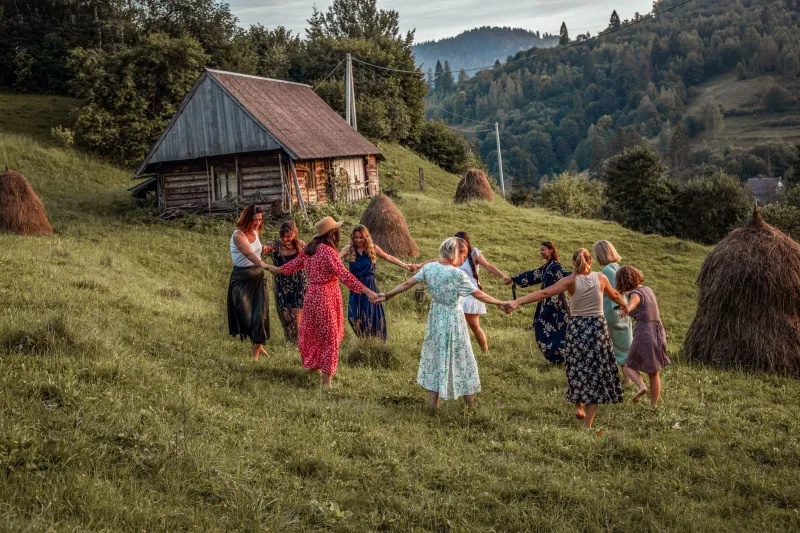
In a culture that has optimized nearly every domain of human experience for efficiency and output, that insistence feels less like an ancient teaching and more like a necessary correction. The gopis danced in a circle, each one fully present, each one irreplaceable, none of them keeping score. American women, it turns out, are paying close attention.