Sacred Syllables on the Beat: How Indian-American Artists Are Weaving Vedic Sound Into Hip-Hop and R&B
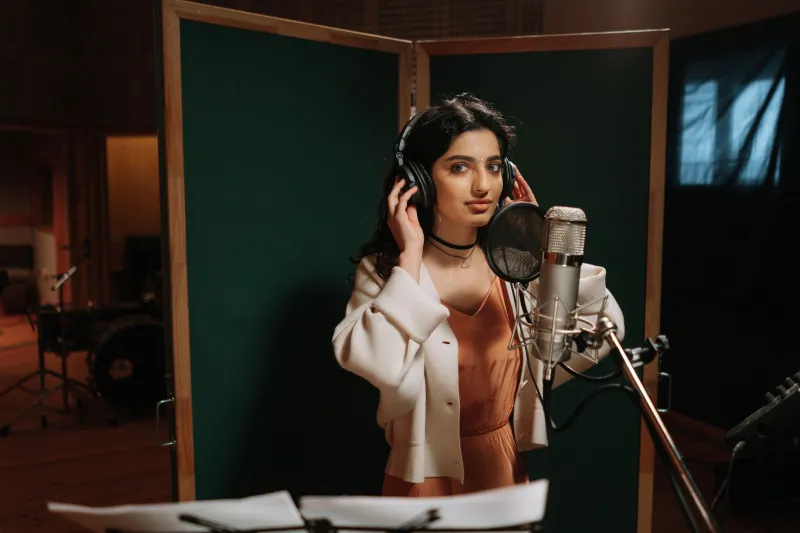
In a recording studio in Atlanta, a young producer named Arjun Mehta is doing something his grandfather could not have imagined. He is layering a field recording of his grandmother reciting the Gayatri Mantra over a slow, stuttering trap beat — 808 bass rolling beneath Sanskrit syllables that are, by conservative scholarly estimates, at least three thousand years old. The result is neither purely devotional nor purely commercial. It is something else entirely: a new language assembled from two very different inheritances.
This is happening across American cities, from the studios of Brooklyn to the home setups of second-generation artists in the Bay Area and Houston. A distinct wave of Indian-American musicians is finding that the sacred sounds of their ancestral tradition — mantras, raga-inflected vocal runs, the drone of the tanpura, the rhythmic mathematics of tala — are not obstacles to contemporary relevance but, in fact, extraordinary raw material for it.
A Diaspora in Search of Its Own Sound
For decades, the Indian-American experience in popular music followed a familiar arc. Artists either assimilated fully into Western genres, often erasing markers of cultural specificity, or they occupied a niche world of classical and semi-classical performance that rarely crossed over into mainstream American consciousness. The space between those two positions — the space where identity could be held in full complexity — was largely unmapped.
What is emerging now is a deliberate cartography of that space. Artists and producers who grew up attending both Carnatic music lessons on Saturday mornings and listening to Kendrick Lamar and Frank Ocean on Sunday afternoons are finding that these two sonic worlds are not as incompatible as their parents' generation might have assumed.
The technical reasons for this compatibility are genuinely interesting. Indian classical music, particularly in its vocal traditions, operates on microtonal scales and ornamental techniques — gamakas, meends, and oscillations — that share a surprising kinship with the melismatic phrasing of gospel-rooted R&B. The cyclical time structures of tala, with their complex subdivisions, resonate with the polyrhythmic logic of hip-hop production. And the drone-based harmonic philosophy of North Indian classical music finds an unexpected cousin in the sustained, atmospheric textures of contemporary electronic music.
The Mantra as Sample
Perhaps the most provocative element of this emerging genre — if it can yet be called one — is the use of mantras as sonic material. For artists who grew up hearing these sacred phrases in temple settings or during family puja, the decision to place them within a hip-hop context is not taken lightly.
Nisha Acharya, a New Jersey-based singer and producer who releases music under the name Nishya, describes the process as deeply personal and, at times, fraught. "There are mantras I will never sample," she says, "because they belong to specific ritual contexts and I don't feel I have the authority to move them. But there are others — particularly the ones my mother sang to me as lullabies — where I feel the act of carrying them into new spaces is itself a form of devotion."
This distinction — between appropriation and transmission, between exploitation and reverence — is one that artists in this space navigate with considerable care. Many consult with family elders, Sanskrit scholars, or the gurukul teachers who shaped their early training before incorporating sacred material into their work. The process is, in its own way, a continuation of the guru-shishya tradition: seeking permission before proceeding.
Others take a different approach, using not literal mantras but the melodic contours and tonal philosophies of classical Indian music to inform their vocal arrangements. Rajan Pillai, a Los Angeles-based R&B vocalist with roots in Kerala, spent three years studying Carnatic music intensively before recording his debut EP. The result does not quote a single Sanskrit phrase, yet the influence is unmistakable — in the way he approaches a sustained note, in the ornamental curls at the end of his phrases, in the modal quality of his chord choices.
"I wanted the Indian-ness to be structural, not decorative," he explains. "Not a bindi on the album cover. Something that lives inside the music itself."
Producers as Cultural Architects
Behind many of these projects are producers whose work is as conceptually rigorous as it is sonically compelling. In Chicago, a production collective called Ananda Sound has spent the past several years developing what they describe as a "raga-informed" approach to beat-making — one that begins not with a drum pattern but with a chosen raga, whose ascending and descending scale structure then governs every melodic choice in the track.
The process slows everything down considerably. Where a conventional hip-hop producer might build a track in an afternoon, Ananda Sound's method can take weeks. But the results have attracted attention from artists far outside the Indian-American community, including several prominent R&B vocalists who have sought out the collective specifically for the meditative, unhurried quality their productions carry.
"American music right now is hungry for depth," says one of the collective's founders, who goes by the name Deepak Nada. "People can feel when something has roots. They may not know what a raga is, but they feel the difference between a melody that comes from a living tradition and one that was assembled from a sample pack."
Young Listeners, Ancient Frequencies
The audience for this music is, perhaps surprisingly, not exclusively South Asian. While Indian-American listeners have responded with particular intensity — many describing the experience of hearing a mantra over a hip-hop beat as unexpectedly emotional, a sudden recognition of something long carried but rarely named — the music has also found receptive ears among Black American listeners, Latino audiences, and young Americans broadly interested in spiritual and contemplative practice.
This cross-cultural resonance speaks to something important about the current American cultural moment. At a time when younger generations are actively seeking alternatives to the relentless pace of digital life, music that carries the frequency of ancient devotional practice — even when dressed in contemporary production — offers something genuinely rare: a sense of depth, continuity, and sacred attention.
For Indian-American artists, this wider reception is both gratifying and, occasionally, complicated. The same music that helps them claim their full identity can also be flattened into exoticism by audiences who hear only the novelty of the fusion rather than the spiritual seriousness behind it.
A Tradition That Has Always Traveled
It is worth remembering that Indian classical music has never been static. The bhakti movement carried devotional song into the streets and marketplaces of medieval India, deliberately breaking caste and class barriers through the democratizing power of music. Sufi qawwali crossed linguistic and religious boundaries across the subcontinent for centuries. Filmi music absorbed jazz, classical, folk, and Western pop with extraordinary promiscuity throughout the twentieth century.
What Indian-American musicians are doing today is, in this light, less a rupture than a continuation — the latest instance of a tradition that has always known how to travel, how to adapt, and how to find new vessels for ancient devotion.
At Krushna Kunj, we believe that the sacred does not diminish when it moves into new forms. It extends. The mantra that once filled a temple courtyard in Tamil Nadu now moves through studio monitors in Atlanta, and something essential — some frequency, some intention — makes the journey intact.
The microphone has always been waiting for this.
