Returning to the Body: How Classical Indian Dance Is Becoming a Homecoming for the Diaspora
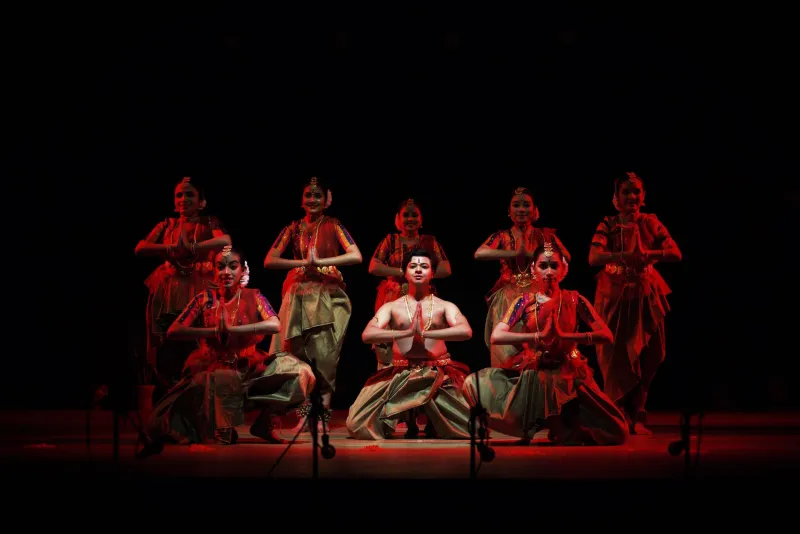
The studio in a converted warehouse in East Austin is not what most people imagine when they picture Bharatanatyam. There are no ornate temple carvings, no silk-draped altars. There is a wooden floor worn smooth by years of stamped rhythms, a mirror that runs the full length of one wall, and the sound of a woman counting beats in Tamil while her students — most of them in their twenties and thirties, many of them second-generation Indian-Americans — move through the foundational posture of aramandi, knees bent and turned outward, spine long, arms extended in precise geometric lines.
The instructor, Kavitha Sundaram, trained for fifteen years in Chennai before relocating to Texas. She has been teaching for a decade in the United States, and she has watched her student population change. "When I first started here, most of my adult students were learning for cultural reasons — to stay connected, to pass something on to their children," she says. "Now I have students who come to me because they are in therapy and their therapist suggested movement work. I have students who come because they feel disconnected from their own bodies. They are not coming for performance. They are coming to feel at home in themselves."
The Particular Alienation of the In-Between Body
The experience of inhabiting a body that does not fit cleanly into any single cultural narrative is one that many Indian-Americans know intimately. In predominantly white spaces, the body is marked as foreign — too dark, too different, carrying the residue of food smells and religious practices that mainstream American culture has not always welcomed. Within South Asian community spaces, the body may be subject to different but equally pointed scrutiny — too Americanized, insufficiently modest, failing to perform the correct signals of cultural belonging.
This double bind creates what several movement therapists describe as a kind of somatic homelessness — a condition in which the body itself becomes a contested territory rather than a dwelling place.
Dr. Anjali Mehta, a licensed somatic therapist practicing in the Bay Area who incorporates classical Indian movement principles into her clinical work, has spent years thinking about this phenomenon. "The body holds everything," she explains. "It holds the immigration story, the assimilation pressure, the grief of things lost in translation. What I find with my Indian-American clients, particularly second and third generation, is that the body has often been managed and monitored rather than inhabited. Classical Indian dance traditions offer a different relationship with the body — one that is devotional rather than performative."
Mudras, Memory, and the Architecture of Gesture
Bharatanatyam, one of the oldest classical dance forms in the world, is built around a sophisticated vocabulary of gesture, expression, and rhythmic footwork. Its mudras — precise hand positions, each carrying specific symbolic and narrative meaning — number in the dozens, and their mastery requires years of patient practice. The abhinaya, or expressive dimension of the form, demands that a dancer embody not just physical shapes but emotional and spiritual states: devotion, longing, wonder, surrender.
For practitioners who grew up in the diaspora, this vocabulary often carries an unexpected charge. "The first time I really understood what I was doing with my hands — not just technically, but what the gesture meant — I cried," says Deepa Krishnan, a thirty-four-year-old graphic designer in Seattle who returned to Bharatanatyam after a twelve-year break. "My grandmother used to make that gesture when she prayed. I had seen it my whole childhood and never known what it was. Suddenly my body knew something that my mind had never been told."
This quality of embodied memory — the way classical movement can unlock cultural knowledge stored in the nervous system rather than the intellect — is something that both dance educators and somatic therapists have begun to examine with greater rigor.
The Studio as Sanctuary
Across the United States, from Houston to New Jersey to the greater Chicago area, classical Indian dance studios are quietly expanding their understanding of what they offer. While the traditional arangetram — the formal debut performance that marks a student's completion of foundational training — remains a central cultural milestone, instructors describe a growing awareness that the studio itself serves functions beyond artistic development.
Meera Pillai, who runs a Bharatanatyam academy in Herndon, Virginia, describes her studio as something her students increasingly refer to as a "third space" — neither the pressure-filled environment of professional or academic life nor the complex emotional terrain of family. "Here, the body gets to be sacred," she says. "That is the word my students use. Not beautiful, not impressive. Sacred."
The distinction is meaningful. In a cultural moment saturated with body-image messaging and the performance pressures of social media, the devotional framework of classical Indian dance offers an alternative metric for physical experience. The body is not evaluated for its appearance but honored for its capacity to carry meaning, to express devotion, to become a vehicle for something larger than individual self-presentation.
Movement as Decolonization
Several younger practitioners and educators are articulating the political dimensions of this reclamation explicitly. For third-generation Indian-Americans in particular — those whose connection to South Asian culture is often mediated through the interpretations of earlier generations rather than direct lived experience — engaging with classical movement forms can feel like a deliberate act of cultural recovery.
"My parents grew up being told to assimilate," says Nandini Rajan, a twenty-six-year-old dancer and educator based in Atlanta. "They were told their culture was something to manage carefully in public. I am learning Bharatanatyam as a way of saying: this is not something to manage. This is something to embody fully, without apology."
The language of somatic healing and cultural decolonization may seem like a contemporary overlay on an ancient art form, but practitioners and scholars alike note that Bharatanatyam has always been understood as a spiritual discipline in its classical context — a path toward moksha, or liberation, as much as an aesthetic achievement.
In that sense, what appears new is also very old. The body, these dancers suggest, has always been the site where the human and the sacred negotiate their relationship. For diaspora communities navigating the particular pressures of American life, that ancient understanding is proving not merely relevant but quietly transformative.