Light Before Gifts: How Indian Festival Traditions Are Offering American Families a More Meaningful Holiday
Somewhere between the Black Friday stampede and the January credit card statement, a growing number of American families are pausing to ask a genuinely uncomfortable question: Is this what celebration is supposed to feel like?
The American holiday season, concentrated roughly between Thanksgiving and New Year's Day, has become one of the most commercially intensive periods in the global retail calendar. The National Retail Federation consistently reports holiday spending figures in the hundreds of billions of dollars, and yet survey after survey reveals that Americans report higher levels of stress, loneliness, and financial anxiety during this period than at almost any other time of year. The decorations go up earlier each autumn. The sales begin before the previous holiday has ended. And somewhere beneath the noise, the original impulse to celebrate — to mark time, to gather, to renew — grows harder to locate.
Into this landscape, Indian-American families across the United States are introducing a different grammar of festivity entirely.
The Architecture of Sacred Celebration
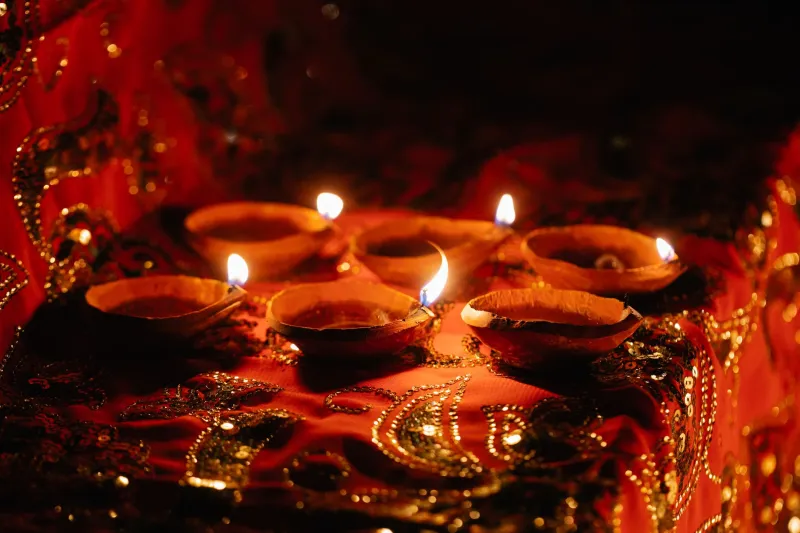
To understand what Indian festival traditions offer, one must first understand what they are designed to do. Unlike the American holiday season, which has become largely organized around retail cycles and calendar convenience, India's major festivals are cosmologically timed. Diwali falls on the new moon of the Hindu month of Kartik — the darkest night of the lunar cycle — and its central act is the lighting of diyas, small clay lamps that push back against that darkness. The festival does not celebrate the absence of darkness. It celebrates the human capacity to respond to it.
Holi, the festival of colors, arrives at the cusp of winter's end, its bonfire the night before — Holika Dahan — marking the ritual burning away of what no longer serves. The explosion of color the following morning is not mere festivity; it is an embodied declaration that renewal has arrived.
These are not simply pretty customs. They are sophisticated symbolic technologies, refined over millennia, for helping communities process the emotional and spiritual rhythms of the year.
Diwali in the American Home
For Indian-American families, the challenge — and the opportunity — has always been one of translation. How does a tradition rooted in the specific geography, climate, and social structure of the Indian subcontinent find authentic expression in suburban New Jersey, or downtown Los Angeles, or a small college town in the Midwest?
The answer, increasingly, is that it finds expression not despite its transplantation, but because of it. The act of deliberately choosing to celebrate Diwali in America — to line the front porch with diyas, to prepare sweets from scratch, to invite neighbors who have never heard of Lakshmi into a candlelit living room — carries a particular intentionality that the holiday's original cultural context did not require.
Sunita Patel, who lives with her family in suburban Atlanta, has hosted a neighborhood Diwali gathering for the past eight years. What began as a small affair for close friends has grown into a block-wide event drawing more than sixty people, the majority of whom have no South Asian heritage. "I never planned to make it a teaching moment," she says with a laugh. "But every year, someone asks me why we light the lamps, and I get to explain that it's about choosing light — not just as a metaphor, but as an act. People respond to that. Especially right now."
The environmental dimension of this response is not incidental. Many Indian-American families who have embraced Diwali as a primary holiday celebration note that its emphasis on handmade diyas, home-cooked food, and communal gathering stands in direct contrast to the waste-intensive consumption of mainstream American holiday culture. Several families interviewed for this piece described a conscious decision to replace a portion of their Christmas gift-giving budget with investments in shared experiences — cooking together, attending classical music performances, or donating to community organizations in one another's names.
Holi as a Template for Renewal
If Diwali speaks to the American hunger for meaning and light in the darkness of late autumn, Holi addresses something equally urgent: the need for genuine release and communal joy.
Holi celebrations have proliferated across American college campuses and urban parks over the past decade, and while some of these events have been criticized for decontextualizing the festival from its devotional roots, the deeper cultural conversation they are prompting is significant. American participants who encounter Holi for the first time — who experience the disarming leveling of social hierarchy that occurs when everyone is equally covered in color — often describe it as unlike any celebration they have previously known.
Dr. Anjali Desai, a cultural anthropologist at a mid-Atlantic university who has studied the American reception of Indian festivals, argues that this response is not accidental. "American celebration culture is very hierarchical," she observes. "There are always distinctions — who has the better party, who spent more, who looks the best. Holi collapses all of that. It is radically egalitarian, and I think Americans are starving for that experience."
A Counterculture of Festivity
What Indian-American families are modeling, whether or not they frame it in explicitly political terms, is a form of cultural resistance. In a holiday landscape increasingly dominated by commercial imperatives, their festivals insist on a different set of values: presence over presents, community over consumption, cyclical renewal over linear accumulation.
This is not a rejection of American life. It is, in many ways, an offering to it — a reminder that the impulse to celebrate is ancient and universal, and that it does not require a shopping cart to be fulfilled.
As Sunita Patel extinguishes the last of her diyas each Diwali night, she describes a feeling that no gift receipt has ever produced. "The house smells like ghee and marigolds. My children are asleep. My neighbors went home full and happy. That is what a holiday is supposed to feel like."