Incense Over Instagram: How Indian Devotional Rituals Are Helping American Millennials Reclaim Their Attention
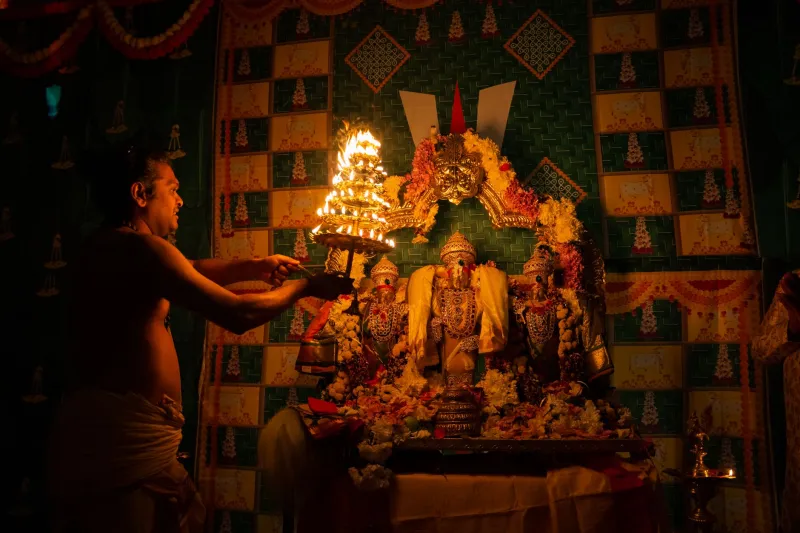
It begins, for many, with a single matchstick.
Before the phone is unlocked, before the notifications cascade, before the algorithm has its first opportunity to dictate the morning's emotional temperature — there is flame, there is fragrance, and there is intention. For a growing cohort of American millennials, the ancient Indian practice of puja has become something deeply unexpected: a firewall against digital overwhelm.
This is not the story of yoga studios or turmeric lattes. This is something quieter, more deliberate, and arguably more radical — the adoption of structured devotional ritual as a conscious counter-movement to the attention economy.
The Problem That Productivity Hacks Cannot Solve
Americans between the ages of 27 and 42 represent perhaps the most thoroughly digitized generation in history. They came of age alongside social media, built careers on platforms, and now find themselves navigating a landscape in which their attention is, quite literally, a commodity being harvested.
The self-help industrial complex has responded with a predictable arsenal: screen time limits, digital detox retreats, grayscale phone settings, and an entire genre of productivity literature premised on the idea that the solution to technological overwhelm is more optimization. Yet for many, these interventions feel like fighting fire with fire — replacing one form of compulsive engagement with another.
"I tried every app, every timer, every notification block," says Priya Mehta, a UX designer based in Austin, Texas, who began incorporating a morning puja practice two years ago after a period of what she describes as "genuine spiritual exhaustion." "The irony of using technology to manage my technology use was not lost on me. What I needed wasn't a system. I needed a sanctuary."
What Mehta found in the structured cadence of devotional ritual — the lighting of a diya, the offering of flowers, the recitation of a simple mantra — was not productivity, but presence. And that distinction, practitioners and wellness counselors suggest, is everything.
What Puja Actually Offers the Overstimulated Mind
At its foundation, puja is a ceremonial practice of honoring the divine through a sequence of intentional offerings and invocations. Rooted in Hindu tradition and practiced across India in forms ranging from the elaborate to the intimately simple, it is, at its core, a technology of attention — one developed not in a Silicon Valley lab but across millennia of human spiritual inquiry.
Dr. Ananya Krishnamurthy, a licensed integrative therapist practicing in the San Francisco Bay Area who works extensively with South Asian diaspora clients and increasingly with non-South Asian millennials seeking contemplative tools, explains its appeal in clinical terms. "Puja creates what I would call a 'ritual container," she says. "It has a beginning, a middle, and an end. It engages multiple senses simultaneously — sight, smell, sound, touch. And crucially, it asks you to be the actor rather than the audience. You are doing something, not consuming something."
This distinction between doing and consuming sits at the heart of why devotional practices are resonating with a generation conditioned to be perpetual receivers of content. Social media, by design, positions the user as a passive absorber of an infinite, curated stream. Puja inverts that posture entirely.
Mantra recitation adds another dimension. The practice of repeating sacred phrases — whether the Gayatri Mantra, a simple invocation of Om Namah Shivaya, or devotional verses drawn from the Bhagavad Gita — occupies the mind's verbal processing capacity in a manner that neurologically crowds out the rumination and compulsive thought loops that characterize heavy social media use. Several recent studies on repetitive prayer and focused chanting have noted measurable reductions in cortisol levels and improvements in sustained attention, lending scientific weight to what devotional traditions have long understood intuitively.
Ritual as Resistance
For many practitioners, the adoption of Indian devotional frameworks carries an explicitly countercultural dimension. In a society that has commodified wellness into a $4.5 trillion global industry, the appeal of a practice that asks for nothing more than a small altar, a stick of incense, and sincere attention is itself a form of quiet rebellion.
Jameson Whitfield, a graphic artist in Brooklyn who began exploring puja after a close friendship with an Indian-American colleague introduced him to the practice, describes it in almost political terms. "Every morning I do my practice, I am choosing not to give that time to a platform," he says. "There is something that feels like sovereignty in that. Like I am deciding what is sacred about my morning, rather than letting an algorithm decide for me."
This framing — ritual as an act of reclaiming sovereignty over one's own attention — appears with striking consistency among practitioners interviewed for this piece. The language varies, but the underlying sentiment does not: devotional structure offers something that no productivity application can manufacture, which is a sense of meaning that precedes and supersedes utility.
The Diaspora Bridge
For Indian-American millennials in particular, this moment carries an additional layer of significance. Many grew up watching parents and grandparents maintain puja practices that, in the urgent business of assimilation, were quietly deprioritized or practiced behind closed doors. The current return to devotional ritual among younger Indian Americans is, for some, as much an act of cultural reclamation as it is a wellness strategy.
"My grandmother had a small mandir in her bedroom that I used to think was quaint," admits Ravi Subramaniam, a software engineer in Seattle. "Now I have one in my apartment, and I understand it completely differently. She was protecting something. She was protecting a part of herself that the world outside could not touch."
That impulse — to protect an interior life from external intrusion — feels acutely contemporary, regardless of one's cultural background.
Building a Practice Without Appropriating a Tradition
For non-Indian practitioners, the question of how to engage with these traditions respectfully is one that wellness educators take seriously. Dr. Krishnamurthy is emphatic on this point. "Engagement should come from genuine curiosity and a willingness to learn the context, not merely the aesthetic," she says. "Understanding why a practice exists — its theological and historical roots — transforms it from a borrowed technique into a genuine relationship with a living tradition."
For those approaching Indian devotional practices from outside the tradition, teachers and community organizations affiliated with Hindu temples and cultural centers across the United States increasingly offer educational programming designed to provide precisely this grounding. The aim, as many practitioners articulate it, is not appropriation but appreciation — and, perhaps more importantly, authentic transformation.
The Altar at the Center of the Morning
There is something quietly profound about the image that emerges from these conversations: Americans of varied backgrounds, in apartments from Atlanta to Portland, beginning their days not with a glowing screen but with a lit flame. Not with the frictionless scroll of a feed but with the deliberate, sensory-rich sequence of an offering.
The phone will come later. The notifications will accumulate. The algorithm will make its claims upon the afternoon. But for those who have discovered the ritual reset that India's devotional traditions offer, the morning — that first, most formative hour — belongs to something older, quieter, and considerably more nourishing.
In the language of Krushna Kunj, this is perhaps what it means for Indian culture to bloom in America: not as spectacle, but as sustenance. Not as content, but as sanctuary.