From Masala to Mainstream: How Indian Food Creators Are Rewriting American Kitchen Culture
For decades, most Americans encountered Indian cuisine through a narrow corridor — the neighborhood curry house, the all-you-can-eat lunch buffet, perhaps a jar of store-bought tikka masala sauce. Flavorful, certainly. But representative of a culinary civilization spanning thirty-six states, hundreds of languages, and thousands of years of agricultural tradition? Decidedly not.
That gap is closing, and it is closing rapidly — not through the expansion of restaurant chains, but through the screens in Americans' pockets and living rooms.
A New Kind of Cooking Teacher
When Priya Iyer, a software engineer turned food creator based in Austin, Texas, began posting videos of her grandmother's Tamil Nadu recipes in 2021, she expected a modest audience of fellow South Indian expats. What she found instead was a comment section filled with names like Melissa, Derek, and Courtney — home cooks from across the United States who had never heard of rasam or kozhukattai, but were eager to learn.
"People kept telling me they had tried Indian food at restaurants but never understood the layers," Iyer has noted in interviews. "They wanted to know why the food tasted the way it did. That curiosity is what I try to answer."
Iyer's experience is not unique. Across YouTube, Instagram, and TikTok, a growing cohort of Indian food creators — many of them first- or second-generation immigrants — are building substantial American audiences by doing something deceptively simple: cooking honestly, explaining thoroughly, and treating their viewers as intelligent adults capable of handling complexity.
Creators such as Archana's Kitchen, Manjula's Kitchen, and newer voices like Nisha Madhulika have collectively amassed millions of subscribers, a significant portion of whom are non-Indian Americans drawn in by the promise of cooking something genuinely different from what their own culinary heritage offers.
Why Indian Cuisine Appeals to the Adventurous American Cook
American home cooking has undergone a remarkable transformation over the past two decades. The rise of farmers' markets, the farm-to-table movement, and the influence of chefs like Yotam Ottolenghi have conditioned a generation of American cooks to embrace unfamiliar ingredients and layered flavor profiles. Indian cuisine, with its sophisticated spice grammar and its emphasis on building flavor through time and technique, fits naturally into this evolved palate.
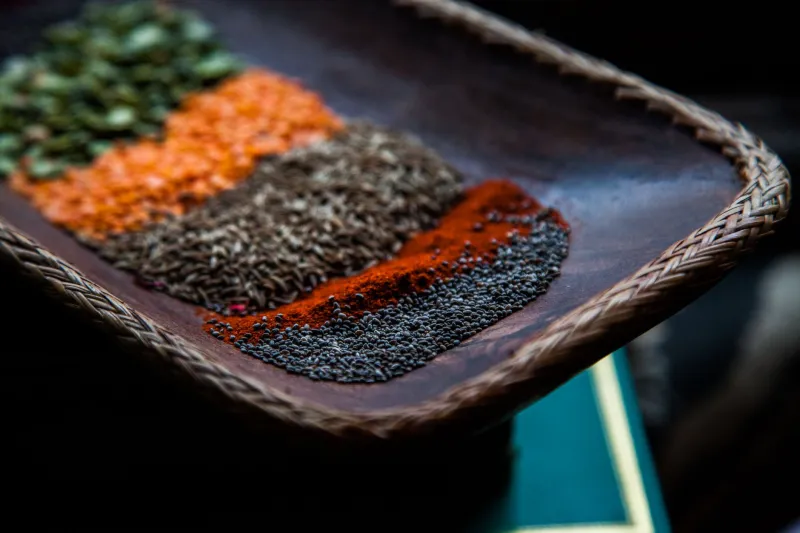
Beyond flavor, there is the matter of health consciousness. Turmeric, cumin, coriander, fenugreek — spices that have anchored Indian cooking for millennia are now staple ingredients in American wellness culture. When a home cook who already adds turmeric to their morning smoothie discovers that the same ingredient forms the backbone of a Gujarati dal, the leap into Indian cooking feels less foreign and more like a natural extension of something already familiar.
Digital creators have been shrewd in recognizing this connection. Many successful Indian food channels now explicitly bridge the gap between wellness culture and traditional cooking, framing recipes not merely as cultural artifacts but as nutritionally sophisticated meals backed by centuries of Ayurvedic understanding.
Democratizing the Family Recipe
Perhaps the most significant contribution of the Indian food creator community is the digitization of knowledge that was, until very recently, held almost exclusively within families. Traditional Indian recipes were rarely written down. They were demonstrated — grandmother to daughter, mother to son — in kitchens where measurements were approximated by feel and seasoning was adjusted by instinct.
That oral and demonstrative tradition, while beautiful, created an obvious barrier for anyone outside the family or community. A person in Columbus, Ohio, with no Indian neighbors and no access to an Indian grandmother, had virtually no pathway into authentic regional Indian cooking.
Streaming platforms and social media have dismantled that barrier with remarkable efficiency. Creators who grew up watching their mothers cook in Chennai or Lucknow or Kolkata are now, in effect, extending that kitchen table to include subscribers across the United States. They are translating not just recipes but the philosophy behind them — why you bloom spices in oil before adding onions, why a dish might call for tamarind in one region and kokum in another, why the same name can describe entirely different preparations depending on which side of the Vindhya mountains you grew up on.
"Indian food is not one cuisine," explains food writer and creator Vikram Nair, who runs a popular cooking channel from Chicago. "It is a continent of cuisines. My job is to introduce people to that continent, one recipe at a time."
Street Food, Festive Feasts, and Everything Between
The breadth of content being produced is itself remarkable. American viewers can now find detailed tutorials on Mumbai's pav bhaji, the fermented complexity of Chettinad cooking, the delicate vegetarian traditions of Rajasthan, and the fiery, coconut-forward curries of Kerala — all presented by creators who speak with the authority of lived experience and the accessibility of skilled communicators.
Festive recipes, once the exclusive domain of family gatherings, have found a particularly enthusiastic American audience. Videos demonstrating how to prepare sweets for Diwali or savory dishes for Holi regularly attract viewers who have no personal connection to these festivals but are drawn by the craft and the story.
This appetite for context — not just the recipe, but the occasion, the meaning, the memory — distinguishes Indian food content from much of the broader cooking media landscape. Viewers are not simply learning to cook; they are being invited into a cultural world.
A Table Set for the Future
The influence of Indian food creators on American kitchen culture is already measurable. Specialty grocery retailers report surging sales of whole spices, lentils, and Indian pantry staples. Cooking classes with Indian themes are among the most popular offerings on platforms like Airbnb Experiences and Cozymeal. And in American book publishing, cookbooks dedicated to regional Indian cooking have found audiences that would have seemed implausible a decade ago.
For the Indian diaspora in America, this moment carries a particular resonance. The foods that were once a source of schoolyard embarrassment — too pungent, too unfamiliar, too foreign — are now the subject of enthusiastic curiosity from neighbors and colleagues. The recipes that grandmothers whispered into the ears of their daughters are now being watched by millions.
At Krushna Kunj, where we believe that culture travels most powerfully through its most intimate expressions, it is difficult to imagine a more eloquent form of cultural exchange than this: a woman in her Austin kitchen, cooking her grandmother's recipe, teaching a stranger in Portland how to make something that tastes of another world — and finding, in that exchange, that the world is not so distant after all.