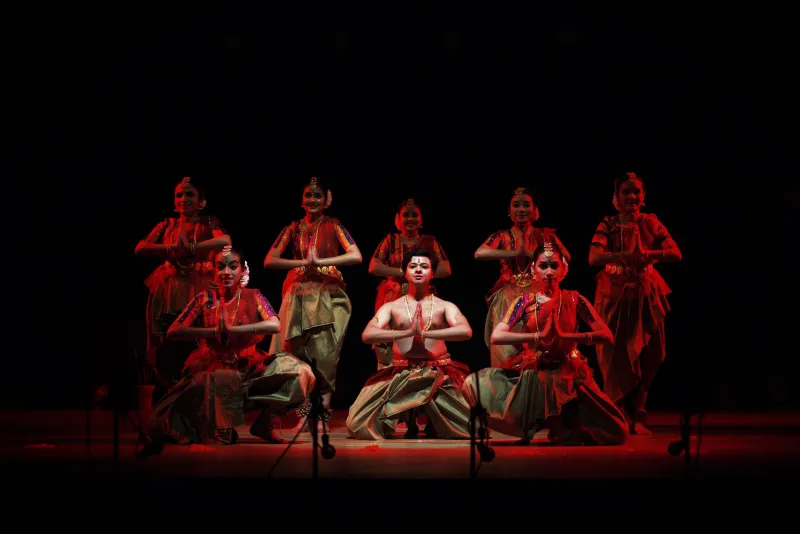
When the Rains Come: Indian Water Ceremonies Are Finding a Home in the American South and West
In late July, when the first real rains of summer finally break over the Texas Hill Country, something has begun to change in certain neighborhoods of Austin and San Antonio. Where once the arrival of monsoon moisture was noted primarily through weather apps and casual complaint about humidity, a quieter, more intentional acknowledgment has started to take root.
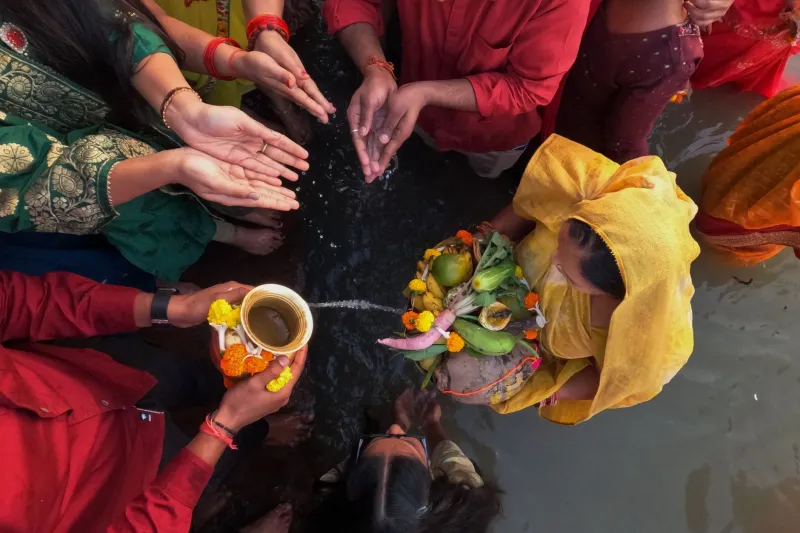
In a park near a creek bed, a small gathering stands at the water's edge. Marigolds float downstream. A Sanskrit verse is offered to the air. Children who have never seen the Bay of Bengal press their palms together and watch the yellow petals catch the current. This is not a scene from Varanasi or Pune. This is central Texas, in the early years of the twenty-first century, and something ancient is learning the shape of a new landscape.
A Tradition Built Around Water's Arrival
In India, the monsoon is not merely a meteorological event. It is a cultural one. The rains carry with them an entire architecture of meaning—festivals, prayers, agricultural rites, and devotional practices that have evolved over millennia in response to the rhythms of a subcontinent whose life depends on seasonal water. Teej, celebrated primarily in northern India, honors the arrival of the rains and the renewal of the earth. Nag Panchami, Varsha Ritu observances, and regional water-blessing ceremonies across Maharashtra, Gujarat, and Tamil Nadu each encode, in their own way, a deep literacy about what it means to live in right relationship with water.
For Indian-American communities transplanted to the American Southwest and South—regions that share with the Indian subcontinent a complex, often fraught relationship with drought and flood—these traditions have taken on a new urgency. The monsoon, as it turns out, does arrive in Texas and Arizona. It arrives in New Mexico and Southern California. And for communities carrying the memory of how to receive it properly, the impulse to honor it has proven difficult to suppress.
From Private Practice to Public Ceremony
What has shifted in recent years is the scale and visibility of these observances. What once occurred quietly within temple compounds or private backyards has begun, in select communities, to move outward—into parks, along riverbanks, and into the awareness of non-Indian neighbors who have found themselves drawn to the ceremonies out of curiosity, kinship, or their own searching.
In Phoenix, a Hindu cultural organization has held an annual water-blessing ceremony at a local reservoir for the past several years, offering Sanskrit mantras for the health of the water and distributing native plant seeds to attendees. The event, which began with roughly forty participants from the local Indian-American community, has grown to include several hundred people of diverse backgrounds, among them environmental activists, Christian and Jewish clergy interested in interfaith environmental practice, and local municipal water officials.
"We did not set out to create a public event," says one of the organizers, a software engineer who moved from Gujarat to the Phoenix metro area in the early 2000s. "We simply wanted to do what our grandmothers did when the rains came. But people saw us and wanted to understand. And then they wanted to participate. The tradition, it seems, speaks to something people here are also hungry for."
A similar pattern has emerged in Houston, where the Indian-American community—one of the largest in the country—has begun incorporating Varsha Puja elements into public park events following the city's increasingly dramatic flood seasons. The ceremonies do not claim to be climate policy. They claim to be something older and, in some ways, more foundational: a communal acknowledgment that human beings live within natural systems, not above them.
The Language of Seasonal Reverence
What attracts non-Indian participants to these ceremonies, facilitators report, is often less the specific theology than the quality of attention the rituals demand. In a cultural moment when most Americans' relationship to weather is mediated through screens and climate anxiety, the experience of standing at a water's edge with intention—of naming the rain, of offering something to it, of receiving it as a gift rather than an inconvenience—can feel genuinely countercultural.
"There is a word in Sanskrit, kritajna, which roughly translates as gratitude or thankfulness," explains a Vedic studies teacher based in Austin who has begun offering monsoon ritual workshops to mixed-background groups. "But it carries within it the idea of recognizing what has been given. Our culture has largely lost the practice of recognizing what water gives us. These ceremonies are, at their core, a practice in recognition."
Climate educators and environmental humanities scholars have begun to take notice. Several universities in the Southwest have invited Indian-American cultural practitioners to speak about seasonal ceremony as a form of ecological knowledge—an acknowledgment that indigenous and traditional relationships to water and weather encode practical wisdom that modern environmental science is only beginning to articulate in its own vocabulary.
The Cities Are Listening
Perhaps most surprisingly, some municipal governments have begun to engage. In several Texas cities, Indian-American cultural organizations have been invited to participate in official water conservation awareness campaigns, bringing monsoon ceremony elements into public programming. In California, where water scarcity has reshaped political and social life, conversations are underway between Indian-American community leaders and local environmental agencies about incorporating traditional seasonal observance into public land stewardship programs.
None of this represents a wholesale adoption of Hindu practice by American civic institutions. The organizers themselves are careful to frame these collaborations in terms of cultural sharing rather than religious propagation. What is being offered, they suggest, is not a theology but a practice—a way of paying attention to the world that has been refined over centuries and that may carry genuine relevance for communities learning, often painfully, to live within ecological limits.
The rains, meanwhile, continue to arrive. In Texas and Arizona, in New Mexico and Southern California, the summer monsoon moves in from the Gulf and the Pacific, as it has for thousands of years, indifferent to borders and newcomers alike. Along certain riverbanks and at certain reservoirs, a growing number of people—Indian and American, Hindu and secular, immigrant and native-born—are learning to stand at the water's edge and offer something back.
At Krushna Kunj, we find in this movement a reminder that culture, at its most vital, does not merely preserve the past. It teaches the present how to see.