Sacred Miles: How Indian-Americans Are Mapping a New Pilgrimage Across the American Landscape
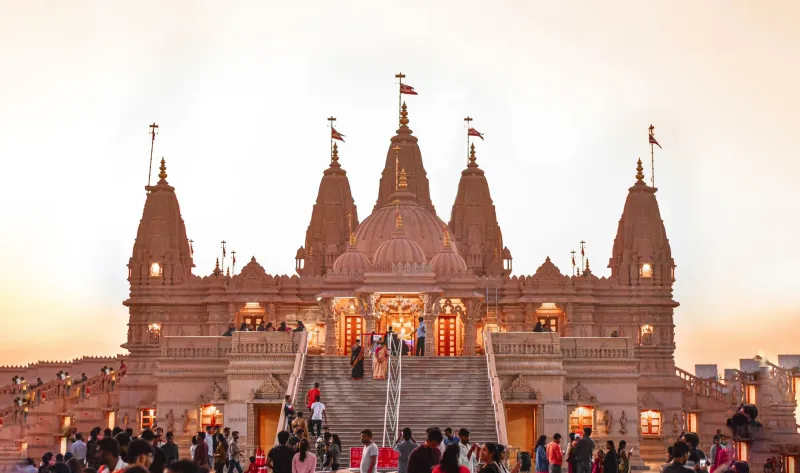
For generations, the idea of tirtha yatra — the sacred pilgrimage — was inseparable from the geography of India. The Ganges. The ghats of Varanasi. The twelve Jyotirlingas. The Char Dham. These destinations carried the weight of centuries, the footsteps of countless seekers pressed into their soil. For Indian-Americans living in New Jersey, Texas, or California, such journeys remained aspirational — events planned around retirement, anniversaries, or moments of profound personal crisis.
But something is shifting. Quietly, and with considerable intention, a growing number of Indian-American spiritual practitioners are refusing to place their devotional lives on hold. Instead, they are drawing new maps — circuits of the sacred that wind through the American continent, connecting temples in Atlanta to ashrams in the Catskills, from the red-rock formations of Sedona to the shores of the Pacific. They are, in the truest sense, making America into a tirtha.
What Tirtha Yatra Actually Means
The Sanskrit word tirtha does not simply mean a holy site. It carries the deeper meaning of a crossing — a ford in a river, a threshold between the ordinary and the transcendent. Classical Hindu texts describe tirtha yatra not merely as tourism with a spiritual veneer, but as a deliberate act of inner transformation accomplished through physical movement, devotional encounter, and the surrender of familiar comfort.
Swami Ananda Prakash, a spiritual teacher affiliated with a Vaishnava center in the Hudson Valley, explains it this way: "When you leave your home and place your feet on the road toward the sacred, something in you begins to loosen. The pilgrimage does not begin when you arrive at the temple. It begins the moment you decide to go."
This understanding — that the journey itself is the practice — has become the philosophical foundation for a reimagined pilgrimage culture among diaspora Hindus.
Temples as Nodes of a Living Network
The United States is home to more than 1,000 Hindu temples, ranging from grand South Indian-style structures in suburban Texas to modest community mandirs occupying converted storefronts in the Midwest. For years, these institutions served their immediate geographic communities. Today, a new generation of devotees is beginning to treat them as interconnected waypoints on a larger spiritual journey.
Priya Nair, a software engineer based in the San Francisco Bay Area, describes a pilgrimage practice she began developing three years ago. "I started with temples I could drive to — the Shiva-Vishnu Temple in Livermore, the Venkateswara temple in Malibu, the Ganesha temple in Calabasas. But then I began flying to Houston for the Meenakshi Temple, to Pittsburgh for the Sri Venkateswara Temple there. Each visit felt different. Each deity, each priest, each community had its own energy."
What Nair describes is not casual religious tourism. She maintains a journal of each visit, noting the puja she attended, the prasad she received, and the inner state she carried into and out of each temple. She plans her itineraries months in advance, often coordinating with other devotees who share her interest in what she calls "temple circuits."
She is far from alone. Online communities on platforms like WhatsApp and private Facebook groups have emerged specifically to help Indian-Americans plan multi-temple journeys. Members share practical details — temple hours, dress codes, festival calendars — alongside more intimate reflections on what each visit meant to them.
Nature as Sacred Geography
Beyond temples, practitioners of this new pilgrimage culture are also reclaiming natural sites as part of their devotional geography. The Hindu tradition has always recognized the sacred in rivers, mountains, forests, and the ocean. In America, this sensibility is finding new expression.
Devout practitioners in the Southwest have begun incorporating visits to the Colorado River and the Grand Canyon into their pilgrimage circuits, offering prayers at the water's edge in the tradition of river worship. Communities in the Pacific Northwest have organized dawn gatherings at Mount Rainier, reciting Vedic hymns to the mountain as a form of the divine. Along the Eastern Seaboard, groups regularly gather at ocean beaches for ceremonial offerings at sunrise.
Dr. Meena Krishnamurthy, a professor of religious studies at a university in the Mid-Atlantic region who has studied diaspora Hindu practice for over two decades, notes that this development reflects a sophisticated theological instinct. "Classical Hindu thought does not confine the sacred to manmade structures. The tradition recognizes divinity in all of creation. What we are seeing is Indian-Americans applying that understanding to their actual environment rather than waiting for permission from a geography they no longer inhabit full-time."
The Role of Ashrams and Retreat Centers
Interspersed within these emerging pilgrimage circuits are ashrams and spiritual retreat centers — some affiliated with established Indian lineages, others more eclectic in character. Centers in the Catskill Mountains of New York, the hill country of Virginia, and the coastal areas of California have become significant nodes in this network.
These institutions serve a function distinct from the temple visit. Where a temple offers a concentrated encounter with the divine through image, ritual, and priestly mediation, an ashram invites the pilgrim into an extended period of immersion — days or weeks of meditation, scriptural study, and communal practice. Together, the temple and the ashram provide complementary experiences that mirror the rhythm of classical Indian pilgrimage, which typically combined brief, intense encounters at major shrines with longer periods of rest and inner absorption.
Raj Patel, a retired physician from Chicago who has spent the past five years developing what he describes as his "American Char Dham" — four sacred sites he visits annually across four different states — speaks of the ashram stays as the connective tissue of his practice. "The temple gives me the encounter. The ashram gives me the time to understand what happened in the encounter. Without both, the pilgrimage would feel incomplete."
Community and the Shared Road
One of the most striking dimensions of this emerging movement is its communal character. While the inner work of pilgrimage is deeply personal, practitioners consistently emphasize the importance of undertaking the journey with others. Groups of families, sangha members, and friends are organizing shared pilgrimage trips — carpooling across states, booking accommodations near temples, and traveling together in a spirit that echoes the traditional yatra parties that once moved across the Indian subcontinent on foot.
For younger Indian-Americans, these shared journeys are also serving as a form of cultural transmission. Parents who might struggle to explain the significance of Vedic ritual at the dinner table find that a weekend pilgrimage to a major temple, experienced alongside grandparents and children alike, communicates something that words alone cannot.
"When my daughter saw the Tirumala-style tower of the temple in Cary, North Carolina for the first time, she went completely silent," recalls Lakshmi Venkataraman, a mother of two from Durham. "That silence taught her more about what we carry in our hearts than any conversation I could have had with her."
A Tradition Continuously Renewed
The pilgrimage, in its deepest sense, has never been about the destination. It has always been about the transformation that occurs when a human being decides to move toward the sacred with deliberate intention. Indian-Americans are discovering that this transformation is not the exclusive property of any particular geography. It belongs, instead, to the quality of attention brought to the journey.
Across the American continent — in suburban parking lots outside gleaming temple complexes, on mountain trails where Vedic hymns rise into thin air, in ashram halls where the scent of incense mingles with the sound of collective prayer — the tirtha is being found. The crossing is happening. The pilgrimage, it turns out, never really ends.