Where Divinity Meets the Doorframe: Indian-American Families Reinvent the Sacred Home
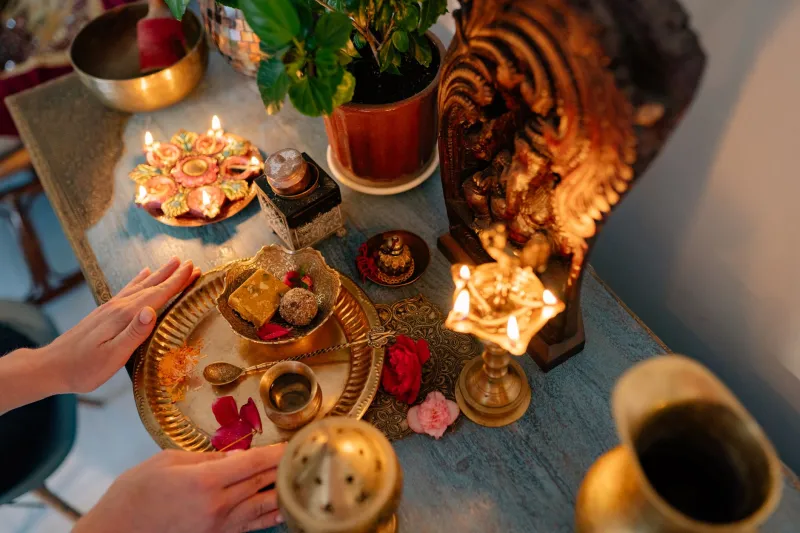
In a two-bedroom apartment in Evanston, Illinois, a small wooden shelf mounted near the east-facing window holds a brass Ganesha figurine, a single oil lamp, and a sprig of dried tulsi. There is no elaborate mandap, no room dedicated solely to worship. Yet every morning, Priya Nair, a 34-year-old software project manager and second-generation Indian-American, lights the lamp, rings a small bell, and begins her day in a moment of deliberate stillness.
"My parents had an entire room in our house in New Jersey," she says. "I don't have that luxury. But I realized the space doesn't have to be large to be meaningful. It just has to be intentional."
Nair's arrangement is modest by traditional standards, yet it reflects a broader and deeply considered shift occurring in Indian-American households from coast to coast. As second- and third-generation families navigate the realities of American real estate, modern minimalism, and a renewed hunger for cultural rootedness, they are reimagining what a sacred home space can look like—and in doing so, are creating something that feels neither fully Indian nor conventionally American, but profoundly their own.
The Puja Room in the American Imagination
For many first-generation immigrants who arrived in the United States during the 1970s, '80s, and '90s, the puja room was a non-negotiable feature of the home. Often situated in the northeast corner of the house in accordance with Vastu Shastra—the ancient Indian science of spatial harmony—these rooms served as anchors of identity in an unfamiliar country. They were dense with iconography, fragrant with incense, and alive with the sound of recorded bhajans.
But the homes their children and grandchildren inhabit tell a different story. Smaller apartments, open-plan layouts, and the aesthetic sensibilities shaped by years of scrolling through Architectural Digest and design platforms have created both a challenge and an invitation. How does one honor a living spiritual tradition within spaces that were never designed to accommodate it?
"That tension is actually where the most interesting design work is happening right now," says Ananya Krishnamurthy, an interior designer based in the San Francisco Bay Area who specializes in what she calls "culturally integrated interiors." Her clients are predominantly Indian-American families who want their homes to feel spiritually grounded without appearing, as one client put it, "like a temple gift shop."
Krishnamurthy approaches each project by first asking families about their daily devotional rhythms rather than their aesthetic preferences. "The space should serve the practice, not the other way around," she explains. "Once I understand how and when someone connects with the divine—whether that's a five-minute morning ritual or a longer evening meditation—the design almost suggests itself."
Vastu Principles, American Proportions
Vastu Shastra, which translates roughly as "the science of architecture," offers a sophisticated framework for orienting living spaces in alignment with natural forces and elemental energies. Its principles govern everything from the placement of the kitchen stove to the direction a bed should face. For Indian-American homeowners, applying these principles to contemporary American floor plans requires both knowledge and flexibility.
Rajan Mehta, a Vastu consultant who works with families across the Midwest and Mid-Atlantic regions, notes that the northeast quadrant—traditionally the zone of spiritual energy and divine connection—is his starting point in every consultation. "In a studio apartment, the northeast corner might be occupied by a closet or a radiator," he acknowledges. "But we can still work with what's there. Sometimes a small shelf at eye level, a clean surface, a source of natural light—that's enough to establish the energetic intention."
Mehta is careful to distinguish between rigid prescription and living principle. "Vastu is not a checklist. It is a conversation between the space and the people who inhabit it. The goal is harmony, and harmony is always contextual."
This contextual approach has resonated deeply with younger Indian-Americans who are drawn to the philosophical depth of their heritage but wary of practices that feel performative or disconnected from daily life. For them, a sacred corner that integrates naturally into a living room—perhaps marked by a low wooden platform, a single framed image of a chosen deity, and a small vessel for fresh flowers—feels more authentic than a separate room that is rarely entered.
Objects That Carry Memory
Beyond spatial arrangement, the objects chosen for these devotional spaces carry extraordinary weight. Many families anchor their home shrines with heirlooms brought from India—a grandmother's silver lamp, a stone idol that has traveled across three generations and two continents, a handwoven cloth that once adorned a temple in Tamil Nadu or Gujarat.
Sunita Patel, a pediatric nurse in suburban Atlanta, describes unwrapping her mother's brass Lakshmi figurine after moving into her first home as one of the most emotionally significant moments of her adult life. "It was like she arrived with me," she says. "I placed her on a little shelf I had built, and the whole room changed. It wasn't just décor anymore. It was a relationship."
This sense of relational devotion—of sacred objects as living presences rather than decorative artifacts—is central to how many Indian-American families experience their home shrines. The space is less a monument and more a daily meeting point, a place where the human and the divine exchange a quiet greeting.
Interior designer Krishnamurthy encourages her clients to resist the urge to over-curate. "There is a temptation, especially for those influenced by minimalist aesthetics, to make everything look perfect and styled," she observes. "But a devotional space should feel lived in. The slightly tilted photograph, the melted wax on the lamp stand—these are signs of genuine use, and they are beautiful."
The Kitchen as Spiritual Threshold
Beyond the dedicated puja corner, many Indian-American families maintain a parallel devotional presence in the kitchen—a tradition with deep roots in Hindu domestic practice. The kitchen, in classical Vastu and in the broader worldview of many Indian communities, is not merely a utilitarian space but a site of transformation and offering. The act of cooking is itself understood as a form of prayer.
For some families, this translates into a small image of a deity mounted above the stove, a practice of offering the first portion of a cooked meal before eating, or simply the maintenance of a specific ritual cleanliness in the kitchen that distinguishes it from the rest of the home.
"My grandmother never entered the kitchen without washing her hands and touching her forehead," recalls Deepa Sharma, a food writer and cultural commentator in Chicago. "She didn't make a big deal of it. It was just part of how she moved through the world. I've started doing the same thing, and it completely changes my relationship to cooking. It becomes an act of care rather than a chore."
A Living Architecture of Belonging
What emerges from these individual stories is a portrait of a community actively engaged in the creative work of cultural translation—not abandoning tradition, but re-articulating it for a new context. The sacred spaces that Indian-American families are building in their homes are neither replicas of ancestral temples nor concessions to assimilation. They are something more nuanced: evidence of a living culture that bends without breaking.
For Priya Nair in Evanston, the small shelf by the east-facing window has become the most important square foot of her apartment. "When I travel for work and come home, the first thing I do is light that lamp," she says. "It tells me I'm back. It tells me who I am."
In the end, that may be the most essential function of any sacred space—not to impress, not to perform, but simply to remind. In a country that can make the work of remembering one's own roots feel like an act of quiet resistance, the Indian-American home shrine stands as both a personal devotion and a cultural declaration.
The altar, however modest, says: we are still here, and we still know where we come from.