Circles of Stillness: How Sacred Geometry Is Reshaping Meditation and Focus in Modern America
In a quiet therapy suite in Portland, Oregon, a licensed counselor named Priya Nair sets a blank circle template in front of her client—a software engineer in his mid-thirties who has spent the last year describing his mind as "a browser with too many tabs open." She hands him a set of fine-tipped pens and says nothing. Within minutes, he begins to draw. By the end of the session, the circle is filled with interlocking petals and radiating lines. He describes the experience, unprompted, as the first time in months he has felt genuinely present.
This is not an isolated anecdote. Across the United States, practitioners working at the intersection of mental health, contemplative tradition, and cognitive science are reporting a quiet but significant surge of interest in mandalas—the sacred geometric designs that have anchored Hindu and Buddhist spiritual practice for more than two millennia. Once encountered primarily as decorative motifs on yoga studio walls or festival tapestries, mandalas are now appearing in neurotherapy clinics, executive coaching programs, school mindfulness curricula, and university research studies. The question being asked with increasing seriousness is not merely whether mandalas are beautiful, but whether they are, in some measurable sense, medicinal.
What a Mandala Actually Is
The Sanskrit word mandala translates, at its most literal, as "circle," but its spiritual and philosophical dimensions extend considerably further. In Hindu cosmology, the mandala represents the universe in microcosm—a visual map of divine order, radiating outward from a sacred center point known as the bindu. In Tantric and Vajrayana Buddhist traditions, mandalas serve as both objects of meditation and instruments of initiation, guiding the practitioner's awareness inward toward the self and simultaneously outward toward an experience of interconnected reality.
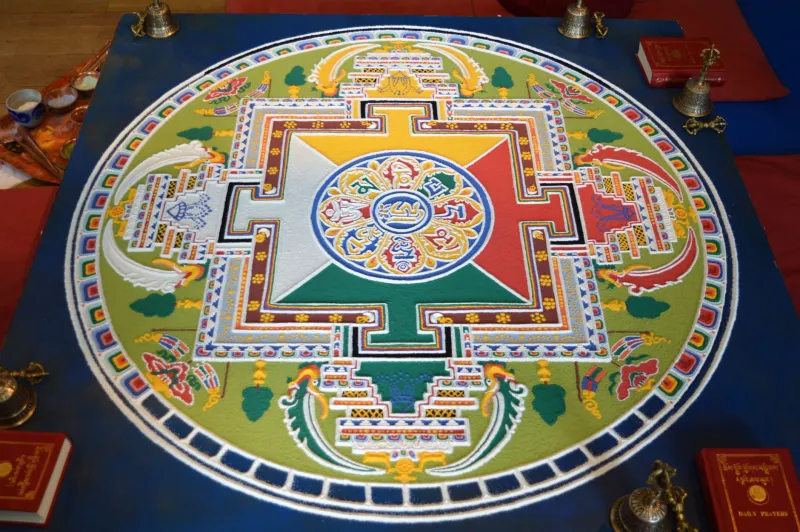
The geometric precision of classical mandalas is not incidental. Each concentric ring, each symmetrical petal, each carefully positioned deity or symbol corresponds to a specific philosophical principle. Creating a sand mandala—a practice in Tibetan Buddhism that involves painstakingly placing millions of grains of colored sand over days or weeks, only to sweep it away upon completion—is understood as a teaching in impermanence as much as a feat of artistic discipline.
For Indian-American communities in the United States, the mandala carries layered significance: it is simultaneously a devotional object, a cultural inheritance, and increasingly, a bridge between ancestral wisdom and contemporary therapeutic language.
The Neuroscience of the Sacred Circle
Researchers at several American universities have begun examining what happens to the brain during sustained mandala engagement. Preliminary findings from studies conducted at institutions including the University of California and the University of New Mexico suggest that the act of coloring or drawing mandalas activates regions of the prefrontal cortex associated with focused attention while simultaneously reducing activity in the default mode network—the neural circuitry most associated with rumination, anxiety, and the restless "mind-wandering" that characterizes both chronic stress and attention deficit disorders.
Dr. Anjali Mehta, a neuropsychologist based in Chicago who has spent the past six years studying contemplative practices and attention restoration, describes the mandala's effect in precise terms. "What we are observing is not simply relaxation," she explains. "It is a form of structured attentional training. The radial symmetry and the repetitive, rule-governed nature of mandala geometry appear to engage the brain's pattern-recognition systems in a way that is simultaneously stimulating and calming. It occupies the analytical mind just enough to quiet the narrative mind."
This dual engagement—demanding enough to prevent distraction, ordered enough to prevent overwhelm—is precisely what makes mandalas distinct from other mindfulness tools, Dr. Mehta argues. Unlike open-awareness meditation, which many beginners find frustratingly formless, mandala practice offers a visible structure that the mind can follow. The circle itself functions as a container.
From Ashram to Art Therapy
The therapeutic application of mandalas in the West owes a significant intellectual debt to the Swiss psychiatrist Carl Jung, who began drawing circular forms in his personal journals in the early twentieth century and later theorized that the mandala represented the archetype of the Self—a symbol of psychic wholeness. Contemporary art therapists have built considerably on Jung's intuitions, developing mandala-based protocols for trauma recovery, grief processing, and anxiety management.
Sunita Rao, an art therapist and trained classical dancer based in the San Francisco Bay Area, has spent the past decade integrating mandala creation into her work with Indian-American clients navigating identity, intergenerational trauma, and acculturation stress. "There is something particularly meaningful about reclaiming a form that belongs to your own heritage," she observes. "For many of my clients, drawing a mandala is not just a therapeutic exercise. It is a homecoming."
Rao is careful to distinguish between the therapeutic use of mandala forms and the commodified "adult coloring book" trend that swept American bookstores in the mid-2010s. While she acknowledges that even simplified mandala coloring offers genuine stress-reduction benefits, she argues that understanding the philosophical architecture of these forms—their directionality, their symbolism, their relationship to breath and intention—deepens their transformative potential considerably.
Mandalas in the Productivity Landscape
Perhaps the most unexpected arena in which mandalas are gaining traction is the American productivity and focus industry. A number of executive coaches and organizational psychologists have begun incorporating mandala-drawing sessions into leadership retreats and corporate wellness programs, positioning the practice not as spiritual exercise but as a tool for cognitive reset.
The logic is straightforward: in an economy defined by chronic context-switching and attention fragmentation, any practice that reliably restores focused awareness carries significant professional value. Several tech companies in the Pacific Northwest and the Northeast have piloted mandala-based focus sessions as alternatives to conventional meditation breaks, reporting anecdotally that participants find the structured, visual nature of the practice more accessible than breath-based techniques.
For practitioners like Nair, this mainstreaming carries both promise and responsibility. "I welcome the wider interest," she says carefully. "But I also feel an obligation to name where these practices come from. The mandala is not a productivity hack. It is a sacred technology developed over centuries within living spiritual traditions. When we bring it into secular contexts, we should do so with acknowledgment and respect."
Keeping the Center Sacred
This tension—between accessibility and integrity, between adaptation and appropriation—runs through nearly every conversation about mandalas in contemporary American wellness culture. For many Indian-American practitioners and scholars, the key lies not in restricting the mandala's reach but in ensuring that its roots remain visible.
Organizations such as the Hindu Endowment Fund and various diaspora cultural centers have begun hosting workshops that teach mandala creation within its original philosophical context, pairing artistic instruction with teachings on yantra (sacred geometric diagrams used in Tantric practice), vastu (the Indian science of spatial harmony), and the cosmological principles that give mandala geometry its meaning.
The goal, as one workshop organizer in New Jersey puts it, is "not to gatekeep the circle, but to keep the light on inside it."
In an age when attention itself has become a contested resource and stillness a radical act, the mandala's ancient proposition—that the path inward is also the path toward wholeness—carries a resonance that transcends any single tradition. Whether encountered in a therapy office in Portland, a neuroscience lab in Albuquerque, or a temple hall in New Jersey, the sacred circle continues to do what it has always done: draw the wandering mind back, gently and precisely, toward its own center.