What Grandmothers Know: The Unspoken Spiritual Curriculum Hidden Inside Indian-American Family Kitchens
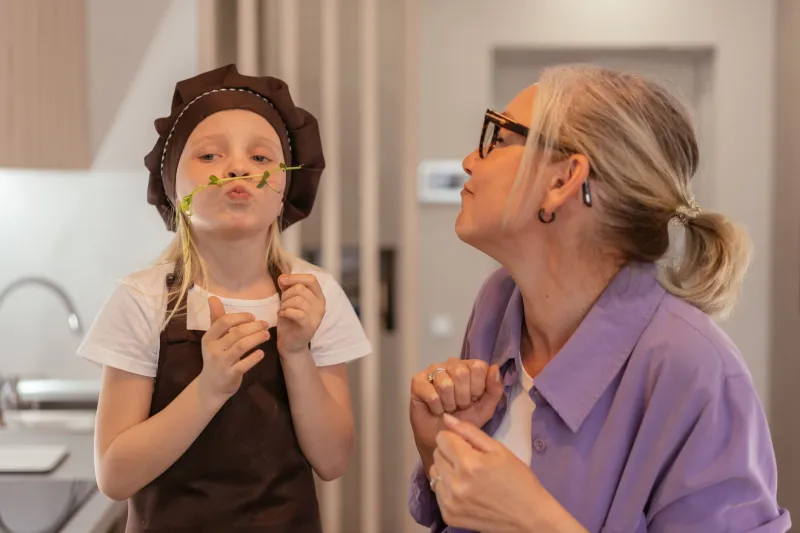
In a modest apartment in Fremont, California, a woman in her late seventies rises before dawn every Tuesday. She does not reach for her phone. She does not switch on the television. Instead, she washes her hands with deliberate care, whispers something soft beneath her breath, and begins arranging small glass jars of spice on the countertop as though preparing an altar for worship. In a sense, she is.
For Savitaben Desai, now in her forty-third year of life in the United States, the kitchen has never been a purely domestic space. It is the room where she continues a conversation begun long before she arrived in this country—a conversation conducted not in words, but in the slow blooming of mustard seeds in hot ghee, the precise moment turmeric meets warm oil, the particular prayer offered before the first flame is lit each morning.
"My mother taught me," she says simply, when asked where she learned. "And her mother taught her. We do not separate the cooking from the praying. They are the same movement."
The Lesson That Was Never Announced
Across Indian-American communities—from the Gujarati enclaves of New Jersey to the Tamil neighborhoods of suburban Houston—a quiet pedagogical tradition has persisted for decades, largely unrecognized by those outside it and often unexamined even by those within. The grandmothers who carry this tradition rarely describe themselves as teachers. They simply cook, and they invite others to watch.
What those observers receive, if they are attentive, is not a recipe. It is a philosophy.
The selection of ingredients, for instance, is rarely arbitrary in these kitchens. Many grandmothers trained in even a passing familiarity with Ayurvedic principles will choose produce according to the season, the constitution of the person who will eat, and the emotional state of the household on a given day. A child who has been anxious might find warm, sweetened milk with ashwagandha appearing at bedtime without explanation. A household mourning a loss might find that heavier, oilier preparations are quietly set aside in favor of lighter, more easily digested foods—a dietary expression of emotional sensitivity that requires no announcement.
"I never told my granddaughter why I made what I made," admits Meenakshi Iyer, a retired schoolteacher now living in Plano, Texas. "But she watched me. And now she is starting to ask."
Timing as Teaching
Perhaps the most underappreciated dimension of this culinary transmission is the role of time—not merely cooking time, but sacred time. In many traditional Indian households, meals are not prepared according to convenience but according to a rhythm that aligns with devotional practice.
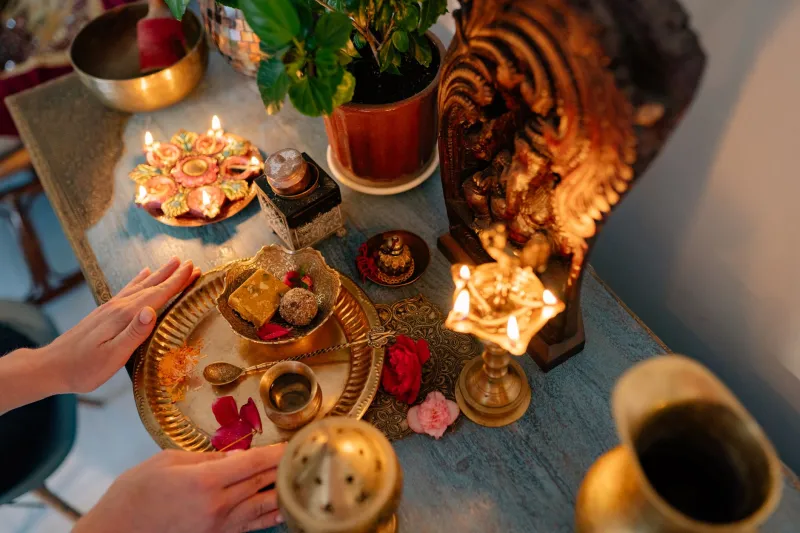
The first food offered in many South Indian and Gujarati homes is not consumed by the family. It is offered to the deity installed in the household shrine, or placed symbolically at the threshold, before any human being is served. This sequence—offering before receiving—encodes a value system that no lecture could communicate as efficiently. Children raised in these homes absorb, often without articulation, the understanding that gratitude precedes consumption, that the sacred has priority over the personal.
Similarly, the timing of certain preparations—sweets made only on auspicious days, particular grains avoided on days of fasting, specific dishes prepared exclusively for festivals—teaches young people to inhabit a calendar that runs parallel to the secular American one. The school year and the fiscal year coexist, in these kitchens, with Navratri and Diwali and Ekadashi, each shaping what appears on the stove.
Recipes as Encoded Memory
Dr. Ananya Krishnamurthy, a cultural anthropologist based in Chicago who has spent the past decade studying intergenerational knowledge transfer in South Asian diaspora communities, describes what happens in these kitchens as a form of "embodied archiving."
"These grandmothers are not simply preserving recipes," she explains. "They are preserving entire cosmologies. The way a woman handles turmeric—the reverence, the care—communicates something about the sacred status of that ingredient that a written recipe cannot capture. The knowledge lives in the body, and it is transmitted body to body."
This embodied quality means that the tradition resists digitization in meaningful ways. A YouTube tutorial can demonstrate technique, but it cannot replicate the grandmother who pauses mid-preparation to explain that this particular dal was always made for the day a family member returned from a long journey—that the dish itself is a form of welcome, a prayer made edible.
These narrative layers, embedded in preparation, are what younger Indian-Americans are increasingly seeking out. In an era saturated with wellness content and spiritual searching, many are discovering that the most profound teachings were always available to them—standing at a kitchen counter, in a grandmother's home, waiting to be heard.
A Generation Turning Back
The pandemic years marked a notable shift in this regard. Cut off from restaurants and communal spaces, and often living in closer proximity to older family members than they had in years, many younger Indian-Americans found themselves in kitchens they had previously moved through only hurriedly. What they encountered surprised them.
Priya Nair, a thirty-one-year-old software engineer in Seattle, describes the experience of spending several months cooking alongside her visiting grandmother as "genuinely disorienting, in the best way."
"I thought I was learning how to make rasam," she says. "But she kept stopping to tell me things. About why we don't waste the water we wash the rice in. About what it means to cook with a settled mind versus a distracted one. About which prayers go with which preparations. I started taking notes, and I realized I was filling an entire journal—and none of it was about the food."
This growing appetite for the wisdom beneath the recipe has begun to manifest in organized ways. Indian-American community centers in cities including Atlanta, Dallas, and the San Francisco Bay Area have hosted intergenerational cooking sessions specifically designed to facilitate this transmission—bringing grandmothers and grandchildren together not simply to produce food, but to sustain a conversation that might otherwise be lost.
What Is at Stake
The urgency of this recovery is not lost on those who study it. As the generation of grandmothers who emigrated to the United States in the 1960s and 1970s grows older, the window for direct transmission narrows. What cannot be recorded in a recipe—the intuition developed over decades, the spiritual context that gives each preparation its meaning—risks disappearing unless younger generations actively seek it.
And yet there is reason for measured optimism. The very qualities that make this knowledge difficult to preserve—its intimacy, its resistance to abstraction, its insistence on being learned through presence—are also what make it powerful. It cannot be mass-produced or algorithmically delivered. It requires a human relationship, sustained attention, and the willingness to stand in a kitchen and simply watch.
In that sense, the tradition asks of its inheritors exactly what it has always contained: the understanding that the most important things are learned not through instruction, but through devotion.
Savitaben Desai finishes her morning preparation in Fremont as the sun clears the rooftops. She places a small portion in front of a framed image of Lord Krishna before serving the rest. Her granddaughter, home from college for the week, watches from the doorway. Neither of them speaks. Something is being passed between them nonetheless.